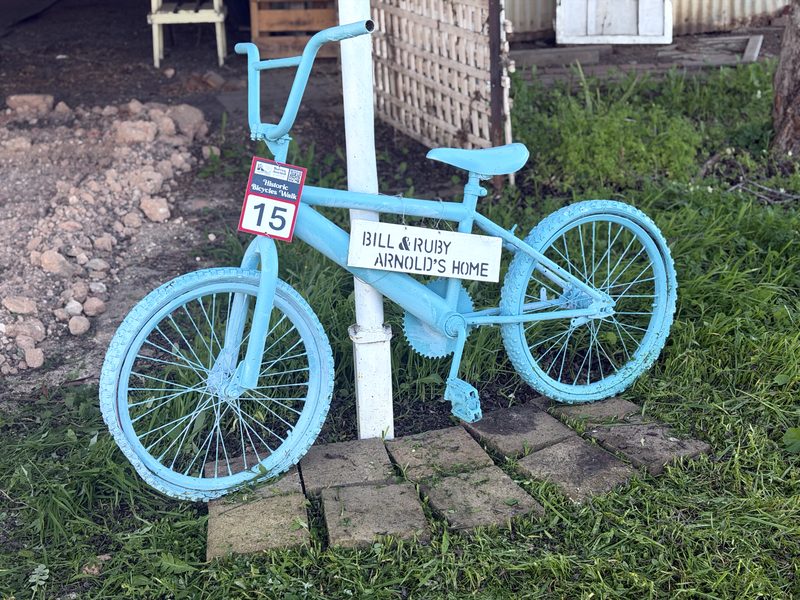
Site 15 – Ruby and Bill Arnold’s House
“Please Respect Private Property”
Please remember this is a private residence. We ask visitors to respect the occupants’ privacy and enjoy the site from the street without approaching or looking into windows.

The home standing on this site once belonged to Ruby and Bill Arnold, a family well known throughout the Burren Junction district. While the house remains today and is being carefully restored, it also represents an important chapter in the history of the district’s water supply and the hardworking teamsters who helped sustain life on the black soil plains.

For much of the twentieth century, the open bore drains that crossed the district were the lifeblood of surrounding properties. Water from the Great Artesian Basin flowed through hundreds of kilometres of shallow earth channels, supplying stock water across the region. To keep this precious water flowing, the drains had to be cleaned regularly—a demanding job known as delving.

During the early decades of the twentieth century, teams of bullocks carried out much of this work. Men such as Frenchy Humble and Jack McCann became well known throughout the district as they travelled from property to property, using their powerful bullock teams to clean bore drains, construct dams and undertake earthmoving work. Their efforts helped shape both the landscape and the farming communities of the Burren district.

In later years, the work passed to Bill Arnold, whose magnificent horse team became a familiar sight across the plains. Working with remarkable skill and patience, Bill and his horses travelled many kilometres cleaning bore drains and ensuring the precious artesian water continued to reach surrounding properties.

The horse teams became part of everyday life in Burren Junction. They represented a time when heavy work depended not on machinery, but on experienced teamsters and well-trained horses working together. It was slow, physically demanding work, yet it was essential to the survival of farming families throughout the district.

By the early 2000s, a new era had begun. To conserve valuable artesian water and improve environmental outcomes, the open bore drains were progressively replaced with underground pipelines delivering water directly to storage tanks and watering points. While this marked the end of an important chapter in rural life, water remains central to life in Burren Junction.

Even today, the village has no reticulated town water or sewerage system. Most homes rely on their own shallow bores, generally around 14 metres deep, together with rainwater tanks and septic systems. This continuing self-sufficiency reflects the resourcefulness that has always been part of life in Burren Junction.

Today, the Arnold family home remains a reminder of those earlier days. Together with the photographs and painting of Bill Arnold’s horse team, it tells the story of the hardworking men, horses and bullocks whose efforts kept the bore drains flowing and sustained farming families across the district. Their work helped make life possible on these plains, and the importance of water continues to shape Burren Junction today.

Historical information sourced primarily from Visions of the Plains – A History of Burren Junction and District (2nd Edition) by Judy Field, together with local community recollections.


Photos

Photo Ruby and Bill Arnold’s House Today
The former home of Ruby and Bill Arnold. The house still stands today and is currently being restored, preserving another important piece of Burren Junction’s history.

Photo Delving the Bore Drains
Horse teams cleaning one of the district’s open bore drains. Regular delving was essential to keep artesian water flowing across the surrounding grazing properties.

Photo Bill Arnold’s Horse Team
Bill Arnold’s horse team at work maintaining the district’s bore drains. Skilled teamsters and well-trained horses played a vital role in sustaining rural life across the plains.

Photo Working the Bore Drains
Horse teams were a familiar sight throughout the Burren Junction district, carrying out the demanding work of cleaning bore drains and maintaining the flow of water before modern machinery took over.

Photo Bill Arnold’s Horse Team (Painting)
This painting depicts Bill Arnold’s horse team delving a bore drain on the property “Maxwelton”, Burren Junction. It commemorates a way of life that has now disappeared but remains an important part of the district’s history.

Photo A Way of Life Remembered
The work of the horse teams required patience, strength and remarkable teamwork. Their contribution helped sustain farming families and shaped the history of Burren Junction and the surrounding district.


Delving the Boredrains – Memories of Bill Arnold

BOREDRAINS

Learning the Trade

In earlier times bullock teams, and then horse teams, were used to pull the delver to clean the boredrains. The drains were completely cleaned every year during the cooler months. Silt, weeds, old grass and rubbish were removed and this allowed the water to flow for the next 12 months. In hot summer weather, additional cleaning often had to take place in some areas. Occasionally a log was pulled down the drain to help clear the silt away.

Ross Tuckey from Wee Waa used to pull the delver with a team of bullocks and used to travel 8 or 10 miles a day. At night he camped under the trees. Ross was rather a slow moving person and went about his business in a calm methodical way. In the mornings it took considerable time to yoke up and pack up the camp.

Tom Small took a great interest in the delving process. He was about 7 years old when he went on his first expedition with Mr. Tuckey. He recalls that there were 28 or 32 bullocks in a team which were well looked after and treated with kindness. They were always yoked in pairs. Young bullocks were paired with older ones to “break them in.”

Working with Bullock Teams

Most delving men took an offsider with them as it made the whole operation much quicker. The culverts had to be cleaned out with a shovel and the boredrain gates had to be opened and then closed after the delver had gone through (some gates or gaps were tricky to deal with and took up a lot of time to open and close.)

Ross Tuckey used to call his bullocks to order just by speaking to them. On one occasion some of the bullocks lay down while Ross was talking to someone. When the conversation ended he called each animal by name and it got to its feet and the bullocks moved on. Bullocks were fairly easy to handle. The delver had to be pulled out of the drain each time a culvert was reached and then put back in. This operation required considerable skill.

A Horse Named Rowdy

Later Bill Arnold delved the drains with a horse team. He had about 16 horses yoked up at a time. Bill was very good with his fists and had spent some time going around with the boxing tent. He was also very good at training his animals. He had 2 or 3 good dogs and he just had to speak to one of them and it would give a slacking horse a nip to make it smarten up. Good dogs could also sort out a teamster's horses or bullocks from 2 or 3 other teams and deliver them to where they were supposed to be.

Bill Arnold had a horse called Rowdy which he had trained from an early age. The horse could pull the delver out of the drain by himself. It took a lot of effort though and Rowdy’s stomach was almost on the ground from the exertion. Bill was very proud of Rowdy.

Bill took his horses and wagon to the Sydney Show on a couple of occasions. Much to the amazement of local people the team behaved beautifully. The horses did a fair bit of work before going to Sydney and had the “sting” taken out of them so Bill had them under control. They had a few days at the Show to settle down before they appeared in the ring. They were a major feature and also took part in the Grand Parade.

Delving During Wet Weather

One year when Bill Arnold was delving the drains he was camped under a tree in a paddock not a great way from the Murilla house. His offsider arrived at the house about 9 o’clock one cold night in drizzling rain. “Bills been taken real bad “ he said. Judith and Malcolm had not long finished their first aid courses and were only too happy to put into practice all the precious knowledge stored in their heads. Following all the correct procedures they had Bill in hospital in good time. He was not in hospital for a great while and lived for several more years.

In latter years the delver has been pulled by tractors and the job finished in much quicker time. Even so there have been times of great drama with unforeseen problems occurring. Responsibility for the drains has always fallen on the shoulders of two elected trustees. These men are nearly always landowners and they have the job of seeing that everything is done to ensure that each ratepayer gets as much water as he is entitled to, and the drains are kept in good condition. It is an unpaid position and involves many hours of work.

The Bunyah Bore

The water for the drains comes from an artesian bore. The Department of Land and Water control the system. Annual meetings were held, attended by the chairman, trustees and a secretary appointed by the trustees who often is an accountant.

Bore No. 4063 Bunyah was drilled in December 1909 to a depth of 678.5 metres.

In 1968 Bill Arnold received $400.00 for delving the Bunyah Bore drains.
In 1970 the cost was $8.00 a mile. About 34 miles of drain are serviced from this bore.
In 1988 7.9 litres a second flowed from the bore.
Bunyah bore is situated in a paddock on the western end of Boolcarrol station. There are similar bores and drain systems in this north- western part of the state.

Extract from the Water Act

Extract from Water Act regarding Powers and Duties of Trustees.
Section 55 (1) For the purpose of providing money for exercising their powers and performing their duties under this Part, the trustees may fix and levy rates upon the whole of the lands within the trust district as follows:-
(a) In connection with the supply of water for stock purposes, a rate per acre of the land benefited by the works shall be fixed, and the rate may vary in proportion to the benefit received as aforesaid.
With the Cap and Pipe system being installed the end is in sight for our boredrains.

Credit: Information supplied by Bill Arnold and recorded by Artie Hall and Malcolm Cameron in Woolsheds and Stories – With a Grain of Salt by Judith Cameron.

Historic Photographs

Historic photograph relating to boredrains and Bill Arnold Historic photograph relating to boredrains and Bill Arnold