Site 29 – Burren Bore Baths
 The Burren Junction Artesian Bore has played a vital role in shaping the life and landscape of the district, providing a reliable water source in an otherwise dry inland environment. Today Burren Junction is proudly known as the “Home of the Bore Baths”, with visitors travelling from across Australia to experience the naturally heated artesian waters.
The Burren bore was first drilled in 1921, tapping into the vast underground reserves of the Great Artesian Basin—one of the largest freshwater basins in the world. Stretching beneath much of inland Australia, the basin supplies water to communities, agriculture and industry across Queensland, New South Wales, South Australia and the Northern Territory.
Before the bore was drilled, reliable water was one of the greatest challenges facing settlement in the district. Once artesian water began flowing, Burren Junction and the surrounding pastoral properties were able to develop with far greater confidence. Although the mineral-rich artesian water was never suitable for irrigation because of its naturally high salt and mineral content, it became an invaluable source of water for stock, domestic use and the growing township.
In the early years, the bore flowed continuously under its own natural pressure. Before the bore was capped, there were no valves or pipelines controlling the flow. Water rose naturally from the bore and flowed directly into the original bathing pool before overflowing into an extensive network of open bore drains. These channels carried water across the district to surrounding properties, supplying water for stock and limited domestic use. The bore flowed day and night, with excess water simply continuing along the drains.
Maintaining the bore drains was hard physical work. Horse teams pulled timber delvers through the channels to remove silt, weeds and debris, later replaced by tractors and steel equipment as farming modernised.
The availability of artesian water transformed the region. Together with the arrival of the railway, it helped establish Burren Junction as an important centre for the sheep industry before later supporting the expansion of grain production. Without the water supplied by the Great Artesian Basin, the development of the district would have been very different.
By the early 2000s, however, it became clear that the basin needed protecting. Large volumes of precious artesian water were being lost through evaporation and seepage from the open bore drains, while uncontrolled flows reduced pressure throughout the Great Artesian Basin.
As part of the New South Wales Government’s Cap and Pipe the Bores Program, Burren Junction’s artesian bore was modernised. Beginning in 2006, the bore was capped and the open bore drains were progressively replaced with underground pipelines. To reduce the amount of water needed to keep the baths operating, the large concrete section in the centre of the pool was added, reducing the volume of water required to fill the baths. At the same time, the outlet pipe was made smaller, reducing the amount of artesian water flowing through the baths and into the evaporation ponds. These changes dramatically reduced water losses while helping conserve one of Australia’s most valuable natural resources.
Although the bore is now controlled, the artesian water still rises naturally to the surface under its own pressure. The water temperature remains at approximately 41.5°C, with the flow rate adjusted to suit the season. During the quieter months the flow is reduced to a trickle, while during the bathing season—from the Easter Long Weekend until the October Long Weekend—the flow is increased to maintain the baths for visitors.
After passing through the baths, the water can no longer be released into the former bore drain system. Under current environmental regulations, water that has been used for bathing is regarded as contaminated and must flow into evaporation ponds rather than being reused.
Today the Burren Bore Baths are one of north-western New South Wales’ most popular inland attractions. The adjoining campground attracts thousands of visitors each year, many staying for several days while exploring the district.
For more than a century, the artesian bore has shaped Burren Junction’s history. It has sustained settlement, supported generations of graziers and farmers, and continues to welcome visitors from across Australia. Today it remains at the heart of our community, proudly earning Burren Junction its well-known title—“Home of the Bore Baths.”
Whether enjoying a peaceful soak beneath the stars, watching a magnificent outback sunset or relaxing beneath the shade of the river gums, the Bore Baths have created lasting memories for generations of locals and visitors alike.
Continue Your Journey
If you’re staying at the Bore Baths campground, we invite you to take the quieter back road into Burren Junction rather than returning via the highway.
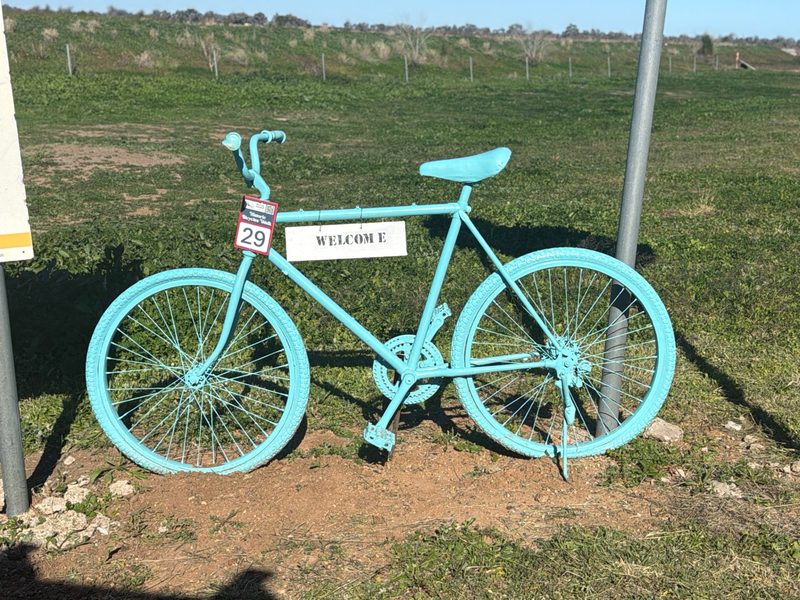
From there you can begin the Historic Bicycles Walk, discovering the buildings, businesses and people who shaped our town over the past 120 years. Along the way you’ll find restored historic photographs, interpretive signs and colourful bicycle sculptures celebrating Burren Junction’s unique history.
The Bore Baths are where many visitors first discover Burren Junction.
The Historic Bicycles Walk is where they discover its story.
Thank you for visiting Burren Junction. We hope you’ve enjoyed your journey through our history and that you’ll return again to experience our warm country hospitality, remarkable heritage and the relaxing waters of the Burren Bore Baths. Safe travels!
Photos
The Burren Bore Baths under a full moon—a favourite experience for visitors throughout the year.
The original Burren Bore Baths, where generations of local families learned to swim and cool off during summer.
The baths during the 1980s before later upgrades to the facility.
The naturally heated artesian water has attracted visitors to Burren Junction for decades.
Today the Bore Baths campground welcomes thousands of travellers from across Australia each year.
The Great Artesian Basin—one of the world’s largest underground freshwater reserves and the source of Burren Junction’s artesian water.
Capping and piping programs have helped conserve precious artesian water for future generations.
The smaller spa pool provides visitors with an even warmer soaking experience.
Families have enjoyed the Burren Bore Baths for generations.
The original bore outlet before the modern capping and piping system was introduced.