Site 25 – School of Arts Hall
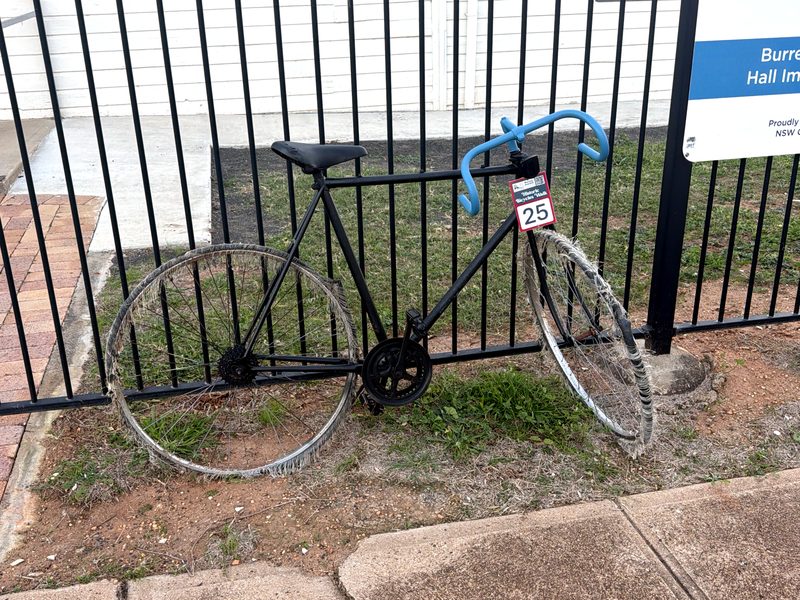 The School of Arts Hall has been the social heart of Burren Junction for more than a century. Generations of local families have celebrated, danced, met, performed, fundraised and mourned together within its walls.
The first recorded community dance was held in July 1905 in the Railway Refreshment Rooms while funds were being raised to build both a public hall and the new Catholic Church. Music was provided by Mr Saunders from Wee Waa, and newspapers reported a large attendance from Burren Junction and the surrounding district.
The first hall was built almost entirely through voluntary labour and public donations, reflecting the determination of local residents to establish a permanent meeting place for their growing community. It originally stood on the corner of Alma and Corunna Streets.
According to local resident Mrs Katie Keyes, her father Harry Jones was one of the hall’s strongest supporters during its construction. She also fondly remembered her mother riding her white horse, “Bosker,” to dances at the old hall.
In those early years, families travelled many kilometres by horse and buggy or sulky to attend dances. Mrs Hilda Boland (née Slack-Smith) recalled dancing until daylight before making the long journey home. Burren residents also travelled to neighbouring towns including Come-by-Chance, Rowena and Boomi for dances and social gatherings.
Throughout the decades the hall became the centre of community life. It hosted:
- Tennis Balls and Cricket Balls
- Church and CWA Balls
- School concerts
- Flower Shows
- Bazaars and fundraising events
- Travelling entertainers
- Public meetings
- Wedding receptions and celebrations
Following the destruction of the Anglican Church in 1941, the hall even became a temporary place of worship until a new church could be established.
Music played an important role in Burren’s social life. Early local pianists including Mrs Sydney Harris and Mrs Henry Harris provided music for countless dances, while visiting orchestras such as Lorna Lance, The Shearers, Tom Holcombe, and the famous White Rose Orchestra ensured many memorable evenings.
The hall remained the heart of Burren Junction well into the twentieth century. Community leaders including Dick Garvey, Julian Church and Frank Holcombe, together with many volunteers, worked tirelessly over the years to maintain and improve the building, including the addition of the supper room.
By 2014 the much-loved hall had deteriorated significantly and was closed because of structural problems, asbestos, electrical faults and safety concerns. Many feared Burren Junction would lose one of its most important landmarks.
Instead, the community came together once again.
Following a major restoration, the beautifully refurbished School of Arts Hall reopened in September 2019, with the official reopening held alongside the Burren Junction CWA Flower Show and Market Day. As local grazier Bill Moore said on the day:
“It’s the start of a new era for the district.”
Today the School of Arts Hall continues to host community events and remains one of Burren Junction’s most treasured buildings—a reminder that while buildings can be restored, it is the people and their community spirit that truly keep a hall alive.
Further Reading
In February 2014 it's reported by the ABC News - Community to Coment On Halls Future
Link to Article
Narrabri - The Couier reported in October 5, 2019 - Burren Blooms at School of Arts Reopening
Link to article
Photos
Photo The beautifully restored Burren Junction School of Arts Hall continues to serve as the centre of community life.
Photo The School of Arts Hall following its restoration, preserving one of Burren Junction’s most important heritage buildings.